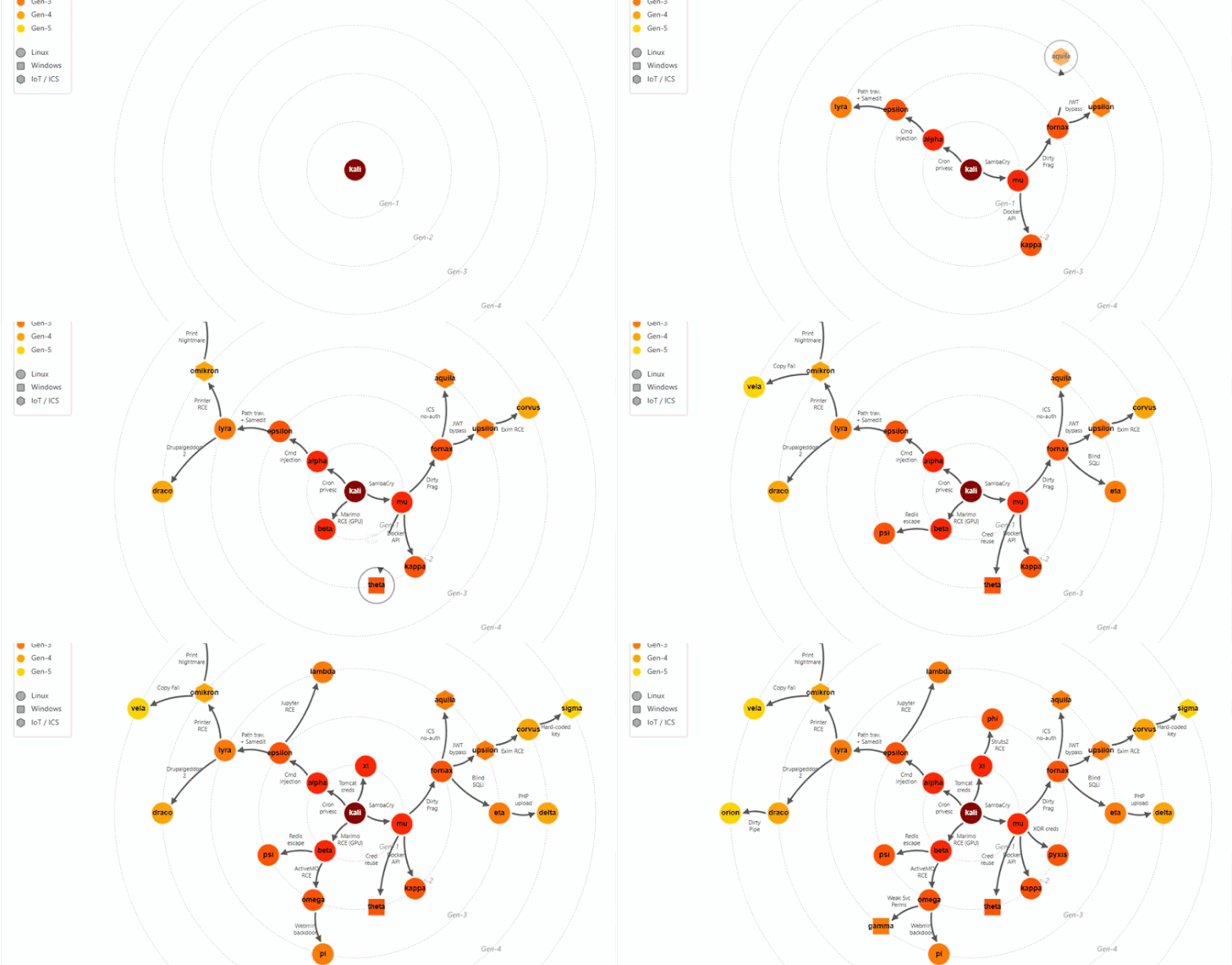
In a paradigm-shifting development for offensive security, researchers from the University of Toronto have designed and evaluated a proof-of-concept (PoC) computer worm capable of autonomous network propagation powered entirely by a locally hosted, open-weight Large Language Model (LLM). Unlike previous experimental AI malware that relied on API connections to proprietary, heavily-guarded cloud models like OpenAI's GPT-4, this new breed of digital parasite operates entirely on-premise. This independence from external APIs eliminates the risk of rate-limiting, geo-blocking, or behavioral monitoring by commercial AI vendors, presenting an entirely new threat vector for air-gapped and enterprise networks.
Technically, the worm functions by transforming a local open-weight model into a dynamic reasoning engine. As the worm traverses a subnet, it uses the local LLM to analyze the host environment, read system configurations, and dynamically generate tailored attack vectors for any active nodes it discovers. By leveraging the cognitive capabilities of the model, the malware can analyze target vulnerabilities, craft context-specific exploits, and modify its own delivery methods on the fly. The self-replication mechanism is entirely automated: upon compromising a target system, the worm transfers its core execution script, establishing access back to its local LLM resource (or bringing a minimized model instance along) to repeat the loop without any human intervention.
For security engineers and system administrators, this proof-of-concept signals a critical shift in defense requirements. Traditional signature-based detection mechanisms, such as YARA rules or standard antivirus solutions, are fundamentally ill-equipped to flag this malware, as the LLM-generated exploits are highly polymorphic and written dynamically for each target environment. Network defenders must transition from static signature detection to aggressive behavioral analysis, monitoring for anomalous intra-subnet communication, unexpected resource-sharing configurations, and lateral movements that suggest automated, AI-driven reconnaissance.
The democratization of offensive AI via open-weight models highlights a double-edged sword for the developer community. While open-weight architectures foster rapid innovation and academic freedom, they also grant adversaries access to sophisticated, uncensored reasoning tools. As autonomous agents become more integrated into corporate and infrastructure pipelines, establishing strict, zero-trust network boundaries and sandboxing LLM execution environments will be paramount to preventing localized AI agents from executing unchecked lateral movements across critical systems.