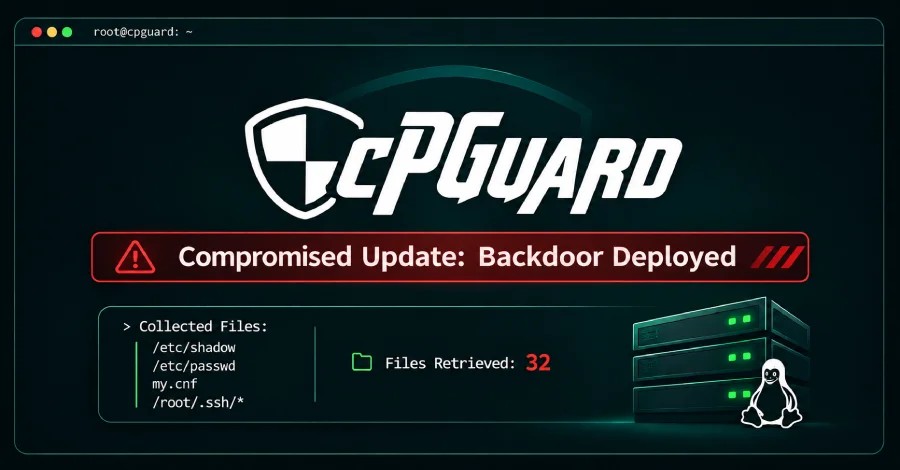
A sophisticated supply chain attack on November 2 saw an attacker compromise the update channel of cPGuard, a security solution for Linux servers, distributing a malicious script that installed a backdoor and exfiltrated highly sensitive data, including password hashes, SSH credentials, and database configurations, from customer systems.
⚡ Key Takeaways
- Supply Chain Compromise: An attacker infiltrated cPGuard's update system using compromised credentials, distributing malicious scripts to customer Linux servers.
- Data Exfiltration: The script installed a backdoor and siphoned critical data including
/etc/shadowpassword hashes, root's MariaDB/MySQL configurations, shell history, and SSH authorization files. - Affected Versions & Timeline: Malicious versions 5.88.12 through 5.88.19 were distributed starting November 2, 02:06 UTC; OPSSHIELD detected the breach within 12 hours.
- Urgent Mitigation Required: All cPGuard servers must update to version 5.88.25 or later, and any potentially compromised server requires immediate password resets and SSH key rotation.
The Anatomy of a Targeted Supply Chain Attack
On November 2, at approximately 02:06 UTC, an unidentified actor gained unauthorized access to the update infrastructure of cPGuard, a Linux server security tool developed by OPSSHIELD. The intrusion leveraged compromised credentials, allowing the attacker to inject a malicious script into the legitimate update packages for cPGuard versions 5.88.12 through 5.88.19. This constituted a classic supply chain attack, where trust in a vendor's distribution mechanism is exploited to deliver malware to end-users.
The malicious payload was designed to execute on customer Linux servers upon update, silently establishing a persistent backdoor. OPSSHIELD acted swiftly, detecting the compromise within 12 hours of the malicious versions going live. The company immediately took steps to clear its infrastructure credentials and halted the distribution of the tainted updates. However, the vector by which the attacker initially obtained the compromised credentials for cPGuard's update system remains under investigation, highlighting a critical unknown in the incident's root cause.
Sophisticated Data Exfiltration and Systemic Impact
Once deployed, the malicious script initiated a comprehensive data collection effort targeting highly sensitive system and user information. Specifically, it sought out:
/etc/shadow: Contains hashed user passwords, critical for offline password cracking attempts./etc/passwd: User account information.- Root's MariaDB or MySQL configuration (
my.cnf): Potentially exposing database root credentials and access details. - Root's shell history: Revealing commands executed, configurations, and potentially hardcoded secrets.
- Root's SSH authorization and known-hosts files: Granting potential unauthorized SSH access to other systems.
Perhaps most alarming was the method of exfiltration: the collected data was uploaded to a compromised account on OPSSHIELD's own licensing server. This tactic allowed the attacker to maintain a low profile within the vendor's trusted ecosystem, effectively using OPSSHIELD's infrastructure against its own customers to stage and retrieve stolen data. As of late November 2 UTC, OPSSHIELD estimated that 32 files, each linked to a unique customer server, were retrieved from this staging server by the attacker. This count, however, only reflects known exfiltrations from the licensing server and may not represent the total number of servers potentially compromised or from which data was copied.
Mitigation, Detection, and Lingering Risks for Administrators
OPSSHIELD has released cPGuard version 5.88.25 and later, which are designed to remove the backdoor and any files left behind by the malicious script. However, the presence of these cleaner versions does not negate the need for immediate and thorough remediation. Crucially, any credentials (passwords, SSH keys) copied by the script may still be valid even after updating, presenting an ongoing risk.
Administrators are advised to perform the following critical steps:
- Immediate Update: Ensure all cPGuard installations are updated to version 5.88.25 or a later release.
- Compromise Detection: Review update logs on all Linux servers for installations of affected versions using the command:
grep 'Successfully updated' /opt/cpguard/logs/install_log. An entry for any version between 5.88.12 and 5.88.19 indicates potential compromise. - Credential Reset: For any server confirmed or suspected of running an affected version, immediately reset all passwords, particularly for root and other administrative accounts. Rotate all SSH keys for root and other privileged users.
- Configuration Review: Scrutinize database configuration files (e.g.,
my.cnf) and shell histories for any exposed secrets that need to be changed.
OPSSHIELD cautions that simply finding an update log entry does not definitively confirm script execution or data exfiltration. However, out of an abundance of caution, any server showing these entries – or even those with missing/incomplete logs that might have been affected – should be treated as potentially compromised. While OPSSHIELD is not currently recommending a full operating system rebuild as a routine step, this stance remains under review as their investigation continues. Administrators encountering other signs of compromise or unable to confirm server cleanliness are urged to contact OPSSHIELD Support for individualized case reviews.
This incident underscores the perilous nature of supply chain attacks, where a single point of failure in a trusted vendor's system can cascade into widespread compromise for its customers. The use of the vendor's own infrastructure for exfiltration highlights a sophisticated attacker's ability to blend in and maximize stealth. For affected organizations, the path to full remediation involves not just patching, but a thorough overhaul of core security credentials and a renewed vigilance against latent threats that might have been introduced during the breach.