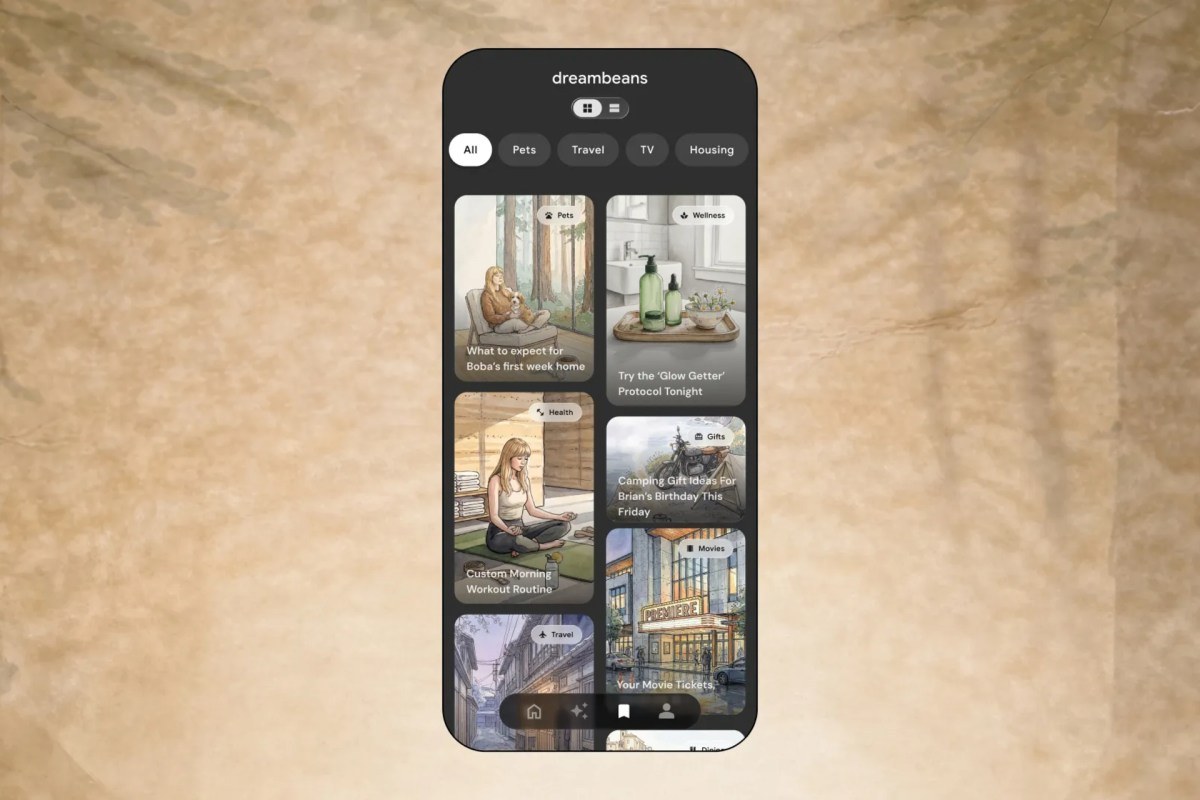
Tech giant Google has officially launched its experimental personalized storytelling app, Dreambeans, in India—marking its first expansion outside the United States. Powered by Gemini and the Veo video-generation model, the app draws directly from user account data to build custom, illustrated narratives without requiring manual prompting.
- Core Development: Expansion to India supports 13 local languages including Hindi, Tamil, and Bengali alongside English.
- Technical Shift: Uses Personal Intelligence technology to cross-reference data from Gmail, Calendar, Photos, Search, and YouTube, animating scenes via Veo.
- Industry Impact: Represents a shift from query-based assistants to passive, contextual media creation, though Hinglish support remains absent.
Zero-Prompt Personalization Meets Video Generation
Unlike traditional conversational AI platforms like ChatGPT or Claude, Dreambeans functions as a zero-prompt media engine. By tapping into connected services through Google's Personal Intelligence framework, the application automatically curates illustrated and animated vignettes about a user's daily life, upcoming plans, and personal interests. Recent feature updates integrated Google's Veo model to transform static AI-generated illustrations into short, stylized video sequences.
Product Manager Gozde Oznur highlighted that India was selected due to an exceptionally high overlap of active power users across Gmail, Google Photos, and Gemini. However, initial usage metrics show a stark contrast with general-purpose tools. Market data from Sensor Tower indicates Dreambeans garnered roughly 55,000 total U.S. downloads since its June debut, registering 29,000 downloads in its first 30 open days—compared to 7.4 million for Meta's Muse and 2.8 million for ChatGPT over equivalent launch windows.
Localization Barriers and Privacy Controls
Despite expanding into a key growth market, technical limitations could hinder adoption. While the app reads multilingual inputs, it cannot generate code-switched outputs like Hinglish, forcing users to select a single operating language per story.
"Dreambeans focuses on proactive, context-aware visual creation rather than reactive text queries, redefining how ecosystem data delivers consumer utility."
The deep integration with personal data also brings user privacy to the forefront. Google emphasizes that users retain granular control, maintaining the ability to toggle connected services or purge personal telemetry at any time. Oznur confirmed that any data deleted from underlying source apps like Google Calendar or Photos is immediately purged from the Dreambeans personalization pipeline.
Industry Outlook & Next Steps
Google views the Indian deployment as a crucial testing ground for proactive agentic interfaces ahead of broader global rollouts expected in Q1 2025. Development teams are currently prioritizing dynamic language-mixing capabilities and performance optimizations for low-bandwidth Android devices. Success in India's complex digital ecosystem will dictate whether zero-prompt contextual feeds become a core standard across future iterations of the Android platform.