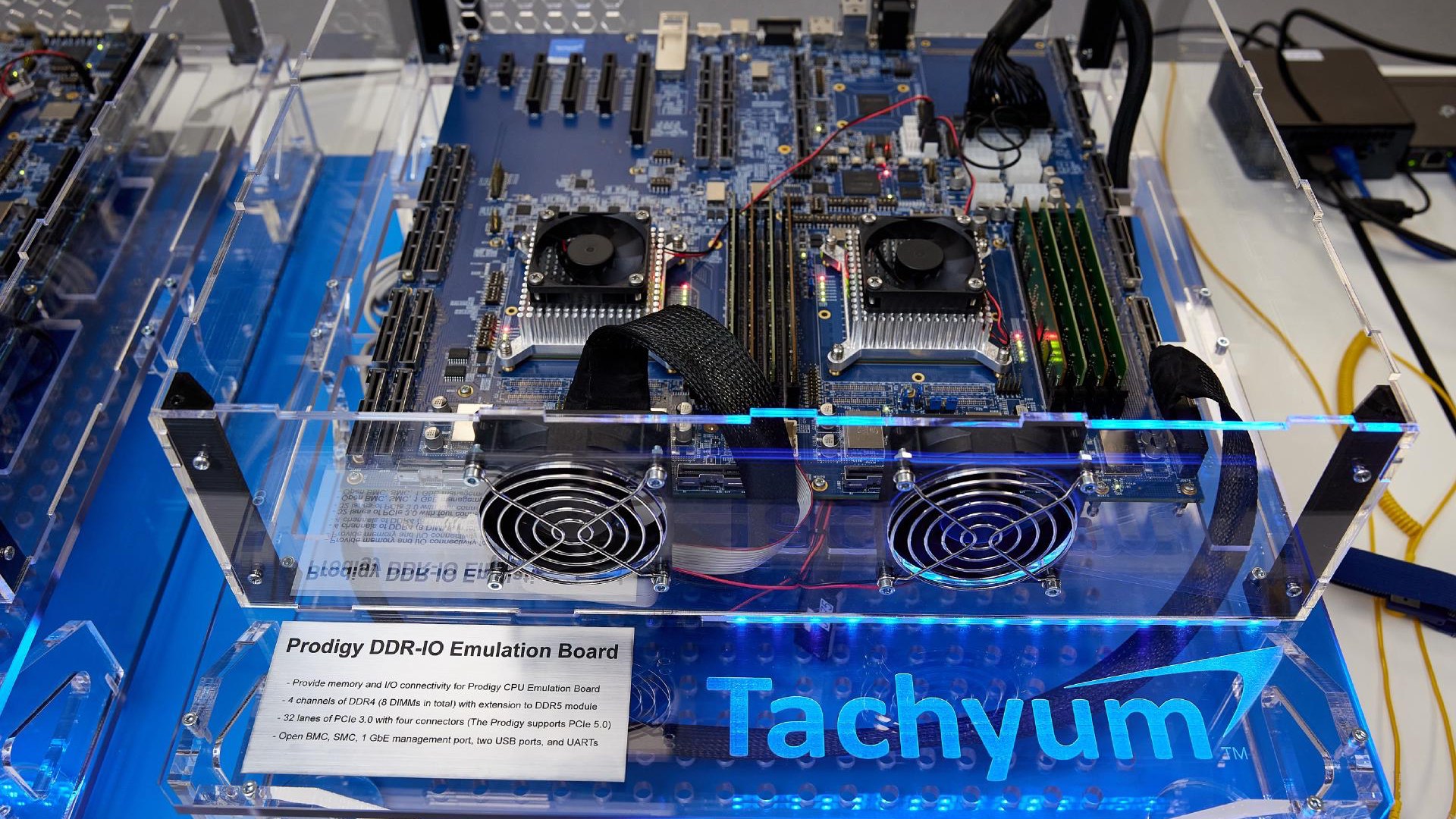
Tachyum s.r.o., the Slovakian subsidiary responsible for the bulk of the Prodigy universal processor's development, has officially filed for bankruptcy in Bratislava, a move that casts a long shadow over the future of the long-promised chip. This action follows years of missed development and production milestones, placing the entire intellectual property of the ambitious project at risk of liquidation.
- Core Development: Tachyum s.r.o. declared bankruptcy in Slovakia after eight years of development and numerous missed targets for its Prodigy universal processor.
- Technical Shift: The Prodigy design underwent radical changes, from an initial 64-core monolithic design on 5nm to a proposed 1,024-core chiplet architecture on TSMC's 2nm-class node with 1,600W TDP, signaling significant development hurdles.
- Industry Impact: The intellectual property for Prodigy, including patents, is now vulnerable to court-ordered sale, potentially impacting future competition in the high-performance computing and AI accelerator markets.
The Prodigy's Protracted Delay and Redesign Saga
Tachyum's journey with the Prodigy processor has been marked by ambitious claims and repeated delays. Introduced in 2018 with a target 2019 tape-out and 2020 commercial availability, the chip's launch was continuously pushed back, first to 2021, then 2022, 2023, 2024, and ultimately 2025. Concurrently, the processor's technical specifications underwent dramatic transformations. The initial 64-core design evolved into a 128-core processor on a 5nm-class process, then a 192-core chip with 16 DDR5 memory channels.
A late 2025 announcement revealed yet another radical redesign: a chiplet-based architecture featuring an astounding 1,024 cores, 24 DDR5 memory channels, and a colossal 1,600W Thermal Design Power (TDP). This proposed iteration, slated for manufacturing on TSMC's 2nm-class node, would have necessitated substantial additional development, pushing commercial availability to 2030 or beyond.
"The continuous and dramatic shifts in Prodigy's architectural specifications, combined with the repeated delays, underscore the monumental challenges Tachyum faced in bringing such an ambitious universal processor to fruition."
Bankruptcy Filings and the Fate of Prodigy's IP
According to court documents cited by Forbes, Tachyum Slovakia voluntarily filed for bankruptcy on October 22, 2026. The Bratislava III Municipal Court subsequently initiated proceedings, deeming the company insolvent under Slovak law. This voluntary filing suggests an acknowledgment of the company's financial distress and inability to meet its obligations.
However, the situation is further complicated by the corporate structure. The ultimate parent company and holder of all Tachyum intellectual property is Cayman Islands-based Tachyum Ltd., which controls U.S.-based Tachyum Inc., which in turn controls the now-bankrupt Slovakian entity. Crucially, the Cayman Islands company holding Prodigy-related patents is itself facing liquidation proceedings. This means that while Tachyum Inc. and Tachyum s.r.o. can be declared insolvent, Tachyum Ltd.'s liquidation could directly transfer control of the Prodigy patents to court-appointed liquidators. These liquidators could then sell the valuable intellectual property to repay creditors, potentially to competing chip developers, marking a definitive end for Tachyum's independent Prodigy aspirations.
Industry Outlook & Next Steps
Should the court formally declare Tachyum s.r.o. bankrupt, a court-appointed trustee will assume control of the company's assets. These assets could include intellectual property related to the Prodigy processor, patents, and development hardware. The potential liquidation of Tachyum Ltd. and the subsequent sale of Prodigy patents introduce significant uncertainty. While current Tachyum management could theoretically attempt to reacquire the patents, they would face competition from other interested buyers, requiring substantial financing. Without a buyer capable of funding further development or a dramatic financial turnaround, the Prodigy universal processor, despite years of promises and architectural ambition, appears to be at the end of its road, leaving a gap in the competitive landscape for high-performance, versatile computing solutions.